
Welding Fixtures
HOME / Custom Engineering
Welding Fixtures: Function and Durability to Stand the Test of Time
Welding fixtures, jigs, trunnions, portable weld tables, fixture and robotic weld cell frames and backbones have been the core business of Rentapen’s 2014. Our expert team produces fixtures that are tailored to your product design, helping you meet your production needs with precise, streamlined and efficient results.
WELDING PROJECTS
Part Assembly Fixtures

Robotic Fixtures

Fit & Tack Fixtures
Work Holding Fixtures
Quality Fixtures Reduce Cost/Improve Production
Top quality, well-designed welding fixtures are an investment that will reduce your costs, improve your assembly quality and be durable enough to withstand the longtime rigors of a continuous welding environment.
We design and build a full spectrum of welding fixtures – from the simplest sub-assembly fit and tack fixtures to multi-step pneumatic and hydraulic clamping fixtures for the highest quality, highest and volume precision parts. When tooling needs go beyond a welding table, Rentapen will engineer a tailored approach with strength, durability and precision or modify a current product (Trunnion, mounting frames, Backbones, etc.) . Our engineering teams design a range from manual tooling to multi-step robotic welding fixtures to solve your production and assembly challenges.
Rentapen has become the go-to resource for robot manufacturers and independent integrators. Our fixtures, designed for the exacting rigors of a robotic welding cell, have literally helped hundreds of manufacturers to achieve the precise repeatability potential that welding robots provide. Rentapen’s strategy using shim packs allows for not only precision adjustability for weld accuracy but also as production fixtures wear down the road, adding a shim even at the cell can bring the fixture back intolerance producing quality weldment. Rentapen’s fixture mounting frames also provide sturdy backbones between head and tail stocks, eliminating the flexing effect of weaker frames, and enabling welding and assembly robots to do the work they are designed to deliver.
Durable Fixtures Designed to Meet Customer Specs
Key to our design process is customer involvement. Once we get an order, we develop a fixture concept that meets your expectations. We typically achieve this through two to three concept review meetings with you, our customer. These can be in-person or online, but they are essential to assure that you receive the welding fixtures you need. We are expert tooling designers, but you are the expert on your parts, your manufacturing processes, and your skilled labor. There are no surprises when we work successful as a team.
Design to Maximize Productivity
By our standards, properly designed and built welding and work holding fixtures will increase your productivity, improve the quality of your parts, deliver repeatability, and be durable enough to last – ultimately paying for themselves many times over. We work first to evaluate the goals and considerations of your design challenges – understanding the type of welding fixtures or jigs required for your unique application, production annual volumes, etc. So we do not overdesign, or under build, or go down the wrong avenue in fixture design regarding budget costs, your return on investments, we work with you to understand:
Production Volume
the number of parts you need to produce each day and the number of welders or robots you intend to use to achieve that goal Estimated Annual or production run requirements, helps keep a design focused.
Type of Weld Fixtures Required
manual clamp, manual welding fixtures; manual fit and tack fixtures with robotic weld out fixture; or fully robotic systems starting with loose parts, utilizing pneumatic, hydraulic or self-centering clamping; and producing a finished assembly in a single or multi-step process
Cost Implications
Product Knowledge
understanding your product’s lifecycle and type – from lightweight precision stamping to heavy burnt plate, and everything in between
Workforce Skill/Availability
recognizing that better tooling allows more flexibility in welder skill
Part Tolerances
manual fit and tack fixtures can allow a skilled welder to compensate for inconsistent component parts. In contrast, robotic welders need the weld joint to be in the same place with little or no gap every time. Repeatable precision tooling and consistent component parts are essential for successful robotic implementation.
Efficiency
creating fixtures that will minimize your production time and cost
Return On Investment Payback
Welding Fixture Types/Characteristics
Manual Clamp, Manual Weld Sub-Assembly and Separate Final Assembly Fixtures
Characteristics
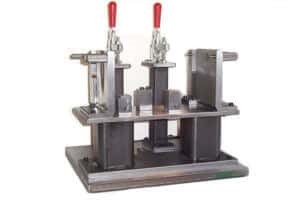
- Inexpensive
- Simplest to design and use
- Good for low-volume assemblies or large heavy parts
- Allows welders to compensate for imperfect parts
- Enables strategic tack welds to prevent distortion during final weld out
- Often used at the start of large, complex assemblies, followed by robotic finish welding
Pneumatic/Hydraulic Clamp
Characteristics
- Typically used in a robotic welding application
- Best for high-volume production needs
- Self-centering clamping and fixture plate features available as needed
- Pneumatic is appropriate for lighter gauge precision parts
- Hydraulic is sometimes required for heavy componentsrequired for heavy components
- Cost justified by volume output
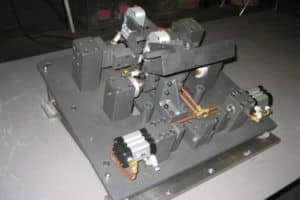
Robotic Weldout Tooling
Characteristics
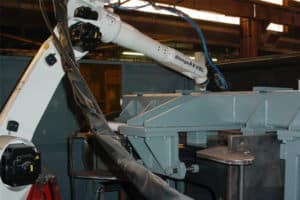
- Simple, open fixtures
- Provides easy access to all weld joints
- Strong backbone for the rotating frame on which to mount fixtures, connected to head and tail stocks
- Strength to eliminate trampolining movement which makes it impossible for a welding robot to produce a repeatable weld
- Usually requires a series of sub-assemblies in advance of final assembly
- Excellent for final stages of assembly process
- Accommodates tack-welded, sub- or final assemblies
- Capacity for three-axis welds are standard, but six- to eight-axis welds for a robotic welding environment are possible
- Maximizes robotic welder utilization
Work Holding Fixtures
Characteristics
- Wide range of design and build experience
- Work holding fixture design applied to assembly, production line, and welding cells
- Facilitates robotics, CNC or manual processes
- Reduces demand for skilled labor
- Eliminates variances in parts positioning achieving exacting results
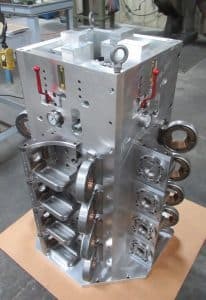
Hand-Applied & Pickoff Jigs
Characteristics
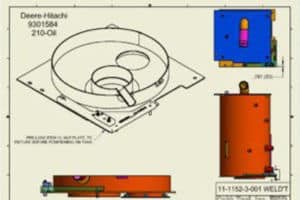
- Simple
- Excellent to add small parts after major component assembly
- Reduces complexity of main assembly fixture
Coming Through Even on Tough Jobs
“I was in a tough spot. A low-margin budget, difficult deadline and tight robotics specifications. Cobb Tool delivered.”
Location/Contact Information
To ask for a quote, define your project, or request a consult: